Suzhou Jiasheng Mould Co., Ltd
Tel: 86-0512-65022105
Mobilr:15312188169
QQ:1276398254
Http://www.jsrbmould.com
E-mail:info@jsrbmould.com
Add: Plant 2, No. 12, Fanrong Road, Xinzhuang Town, Changshu, Suzhou





Suzhou Jiasheng Mould Co., Ltd
Tel: 86-0512-65022105
Mobilr:15312188169
QQ:1276398254
Http://www.jsrbmould.com
E-mail:info@jsrbmould.com
Add: Plant 2, No. 12, Fanrong Road, Xinzhuang Town, Changshu, Suzhou
1.General introduction of rubber mold
Rubber mold, by the way of processing, It is manufactured as that :firstly making engineering design according to the rubber parts’ requirements, then turning the metal material to the rubber moulds according to the engineering documents by mechanical processing; By the application, it is used to produce rubber parts at the engineering parameters such as temperature, pressure, time, etc.
Rubber is a kind of polymer compounds; it is divided into natural and synthetic rubber. The main performance is with high elasticity. There common rubbers are: NBR, ethylene-propylene rubber (EPDM), fluorine rubber (FPM), silica gel, etc. Due to the different rubber with different performance, and different engineering parameters during production process, it requires the designer of rubber mold must consider the type of rubber and how the parts be produced out. In addition, as the rubber mold must be completed after mechanical processing, then processing cost must be considered in the design of rubber mold. In summer, the rubber mould designing must conform to the requirements for mechanical machining and rubber parts’ manufacturing at the minimum cost.
2.Category of Rubber Mould:
According to structure and molding technology, rubber mould can be divided into: compression mold, transfer mold, and injection mold.
2.1 Compression Mould
A surplus of material must be placed in the cavity to ensure total cavity fill. Heat and pressure are applied, causing the compound to flow, filling the cavity and spilling out into overflow grooves.
The structure of the compression mould is as below:
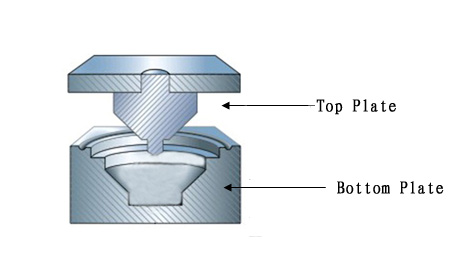
Compression mould has being wildly applied, with the features of low cost and easy operation.
2.2 Transfer mould
Transfer molding differs from compression molding in that the material is placed in a pot, located between the top plate and plunger. The material is squeezed from the pot into the cavity through one or more orifices called gates, or sprues.
The structure of the transfer mould is as below:
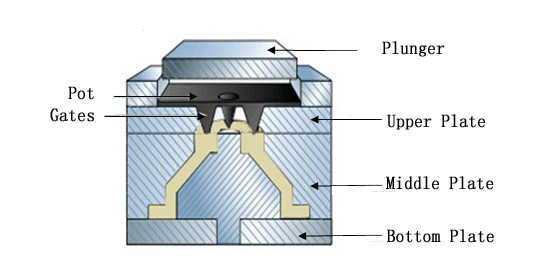
As the raw material is pressed in to cavity in molten state, the product is with high density and quality uniform. Compared with compression mould, the transfer mould is with plunger and gates or sprues structure.
2.3 Injection mould
Injection molding is normally the most automated of the molding processes. The material is heated to a flowing state and injected under pressure from the heating chamber through a series of runners or sprues into the mold. Injection molding is ideal for the high volume production of molded rubber part.
The structure of the injection mould is as below:
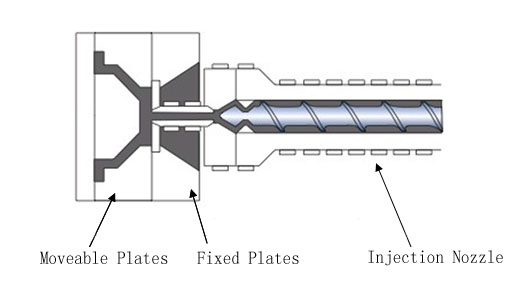
Injection is composed of two parts-fixed and movable half in common. The fixed half, also called the upper mould, it is installed on the fixed hot plate, and connected with injection nozzle of injection machine. The movable half, also called lower mould, it is installed on the movable hot plate of injection machine.
It is much more like plastic injection mould in structure. Its structure would be much more complex than the structure of compression and transfer mold for the same rubber part. Meanwhile It cost is the highest compared with others. But the superiorities are: high efficiency in production, stable products’ quality, and high degree of automation.